Measuring A Roof For Metal Panel Installation
How to Measure a Roof for Metal Roofing
Measuring a roof for metal roofing, whether it be new construction or remodel, can be quite different than measuring for other roofing products like composition shingles. Most metal roofing systems are cut to order, meaning the material purchased is ordered to fit on a specific roof with as minimal onsite cutting as possible. For this reason, one can never obtain too many dimensions when measuring a roof for metal.
Don’t Measure a Metal Roof Just From Plans
Taking as built measurements directly from the roof in question is the best way to insure you will receive the material needed to cover your roof. Using plans to order material can lead to overages or not enough material being delivered which can add time and money at the end of a project. For this reason, Great Northern Metal Company highly recommends taking as built measurements over ordering from a roof framing plan or elevation.
The Best Method to Measure a Metal Roof
The first step to measure a roof for metal roofing is drawing a hand sketch of the roof in plan view. If you are building from a set of plans use the roof framing plan when gathering as built dimensions. The sketch does not need to be to scale but should show all parts of the roof in their relative locations.
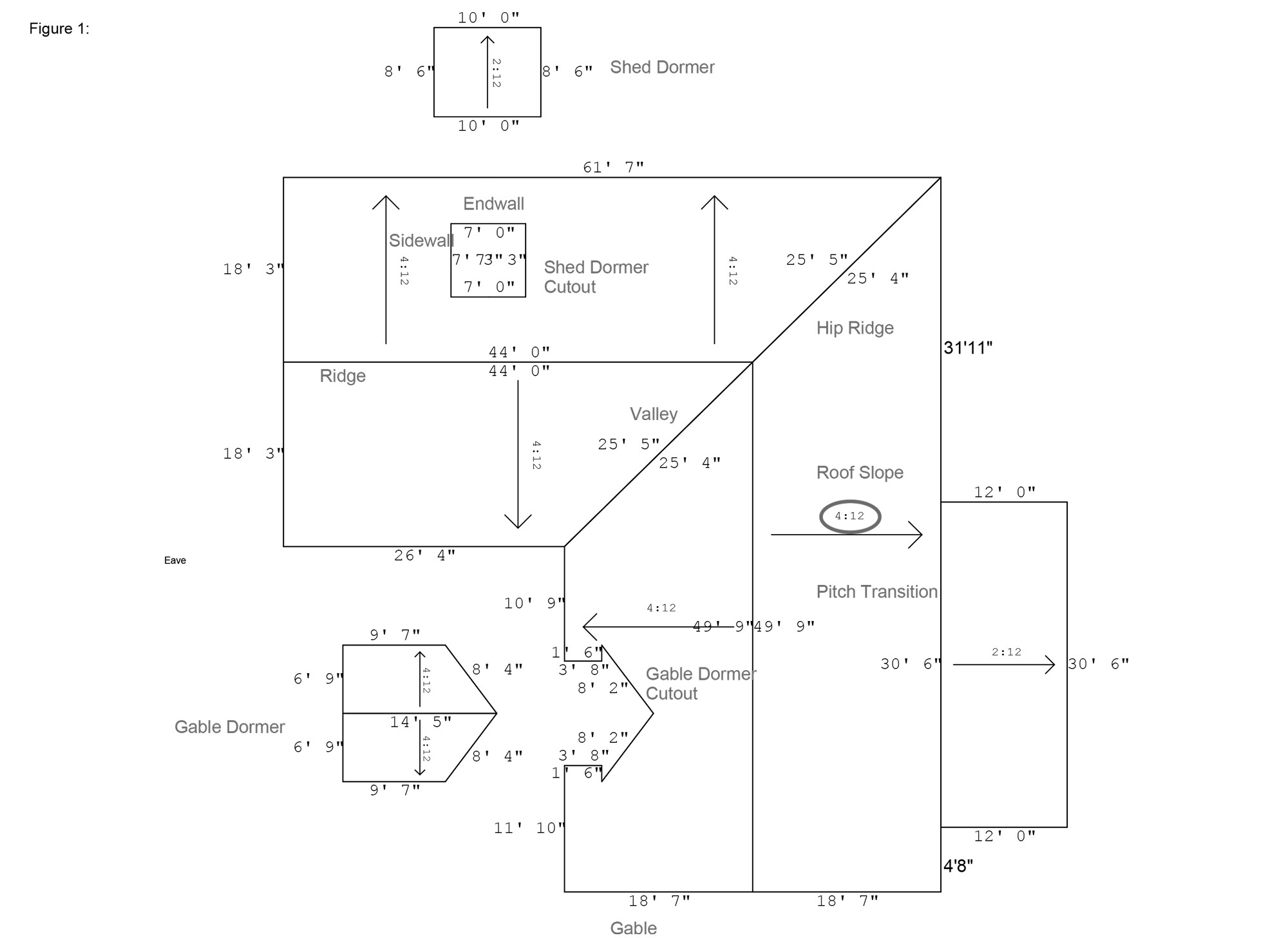
See Figure 1 for a plan view sketch with labeled dimensions. When gathering roof dimensions, treat each plane of the roof as independent of all others. This will help ensure all needed dimensions are taken. Some measurements may seem redundant, but remember the more accurate the measurements prior to order translates to less work in the field as well as less overages and possibly the need to place a makeup order.
Note the shed and gable dormers in figure 1 are drawn away from the plane of the roof they interact with and that there is a separate cut out defined in their respective roof planes. Most dormers have framed overhangs. Showing both the roof of the dormer and the space the walls take up on the main roof plane insures accurate measurements for both roof planes.
Parts of a Roof You May need to Measure
When you are measuring a roof for metal roofing, there are a variety of sections you need to consider. We’ve put together a list of the most common sections and angles so you can be sure to get the exact measurements you need to order your metal roof.
Roof Slope – also referred to as pitch; refers to the inches of rise over a 12 inch run; needed for some trim profiles
Gable Dormer – two pitched roof section projecting away from the plane of a main roof section
Shed Dormer – single pitched roof section projecting away from the plane of a main roof section
Transition – when the plane of a roof changes pitch
Rake – also referred to as gable; the side of a gabled roof running parallel to the slope
Eave – the low side of a roof pitch where water would exit the roof
High Side Eave – The top side of a single slope roof section that does not butt into a wall
Ridge – The peak of a gabled roof; can be vented or non vented
Valley – area of a roof where two roof planes intersect at a right angle and where water runs off
Hip Ridge – area of roof where two roof planes meet at an angle and form a ridge
Endwall – area where the roof meets a wall that is perpendicular to the roof slope.
Sidewall – area where the roof meets a wall that is parallel to the roof slope
Common Panels – a roof sections main panel length
Hip/Valley Panel – any panel leading into a hip/valley situation stepping down in length from the common panel measurement.
Talk to a Metal Roofing Expert Today
Taking the time to accurately measure a roof prior to the ordering process will save time and money in the long run and lead to faster completion times.
If you have any questions about how to measure a roof for metal roofing or whether a metal roof is right for you, reach out to the team at Great Northern Metal Company. We provide metal roofing and siding options for both commercial buildings and homes, allowing you more choice over the design and efficiency of your building projects. Reach out for a quote today.
What Is Sealant for Metal Roofing?
Metal roof sealant helps seal seams, joints, gaps, and other areas where water or air could enter a roofing system. Most gun-grade sealants are applied from a tube and form a bead over or within a joint. Depending on the formulation, the material may remain permanently pliable or cure into a flexible seal.
For metal roofing, flexibility matters. Panels naturally move as temperatures rise and fall, so a sealant used at a moving joint needs to accommodate that movement without losing adhesion.
The location of the seal matters too. A product used at an exposed seam may need different properties than one placed inside a concealed joint.
Sealant also should not be treated as a substitute for proper flashing, fastening, or panel installation. It works as part of the roofing system, not as a fix for a detail that was built incorrectly.
What Is Butyl Tape for Metal Roofing?
Butyl tape is a preformed sealing material typically installed between two roofing components. Instead of applying a bead from a tube, the installer lays a continuous strip of tape along the joint before the materials are fastened together. That makes it especially useful at concealed laps and other locations where two metal surfaces come together.
Butyl stays flexible, which helps it maintain a seal as a metal building experiences normal movement. There are also expanding sealant tapes that serve a similar purpose while filling irregular gaps and accommodating movement within the joint.
Sealant vs. Butyl Tape
The simplest way to think about the difference is application.
Gun-grade sealant works well when you need to apply a bead into a seam, joint, or gap. Butyl tape works well when you need a continuous seal between overlapping or adjoining components.
One is not automatically better than the other. The roof detail determines which type makes sense.
Metal Roof Sealant vs. Butyl Tape: Which Should You Use?
Different roof details put different demands on the sealing product.
These are general guidelines. Always check the roofing-system requirements and the manufacturer’s installation instructions before choosing a product.
4 of the Top Metal Roof Sealants and Butyl Tapes
The right product depends on the joint, expected movement, temperature conditions, and whether the seal will be exposed or concealed.
Here are four options GNMC has tried, tested, and trusts so much that we chose to carry them at our shop.
Best for: Expansion joints, lap seams, and joints that need to accommodate movement.
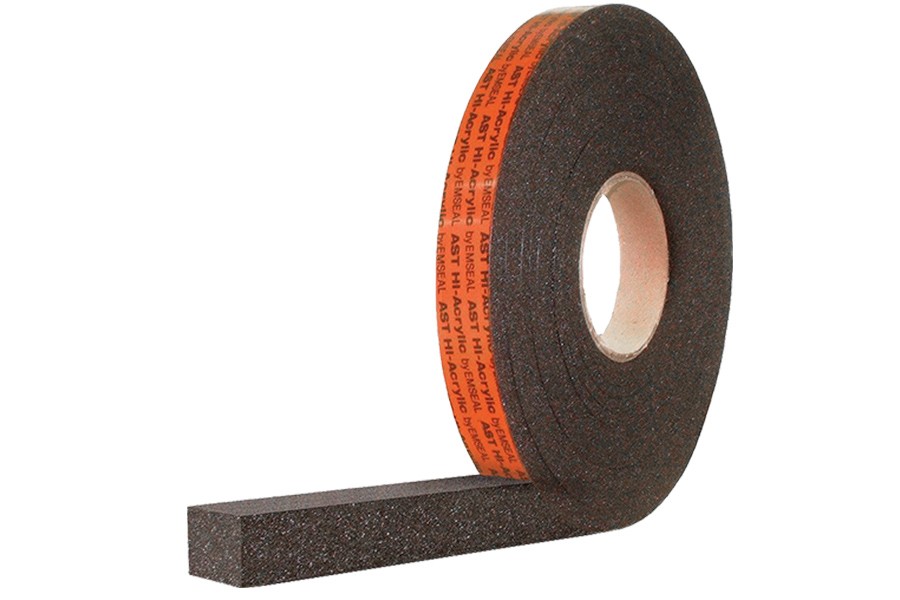
EMSEAL AST Hi-Acrylic Sealant Tape is a self-adhering, open-cell polyurethane foam tape impregnated with acrylic-modified asphalt.
Unlike a standard flat tape, EMSEAL AST gradually expands after it is removed from its packaging. That allows it to conform to the joint and fill gaps along irregular surfaces. For metal roofing and metal buildings, that can be particularly useful around details affected by thermal expansion and contraction.
Why It Works Well With Metal Roofing
One of EMSEAL AST’s biggest advantages is its ability to move with the building. The tape conforms to contours and maintains a seal as metal panels expand and contract. It is designed to help keep out dust, air, wind-driven snow, and moisture through joint details.
It also does not dry out and become hard or brittle over time. Because the material remains compressed within the joint, it is designed to stay in place rather than squeeze out the way some caulks or butyl products can.
Its resistance to UV exposure, aging, and mildew also makes it well suited to demanding exterior applications.
Common Applications
EMSEAL AST can be useful for:
- Expansion and compression joints
- Lap seams
- Mechanically fastened joints
- Irregular gaps
- Metal building details where movement needs to be accommodated
It can also be used alongside several common building materials, including metal, plastic, wood, and concrete.
Interested in EMSEAL AST? Contact GNMC
Best for: Metal panel joints that need a permanently pliable, gun-grade sealant.
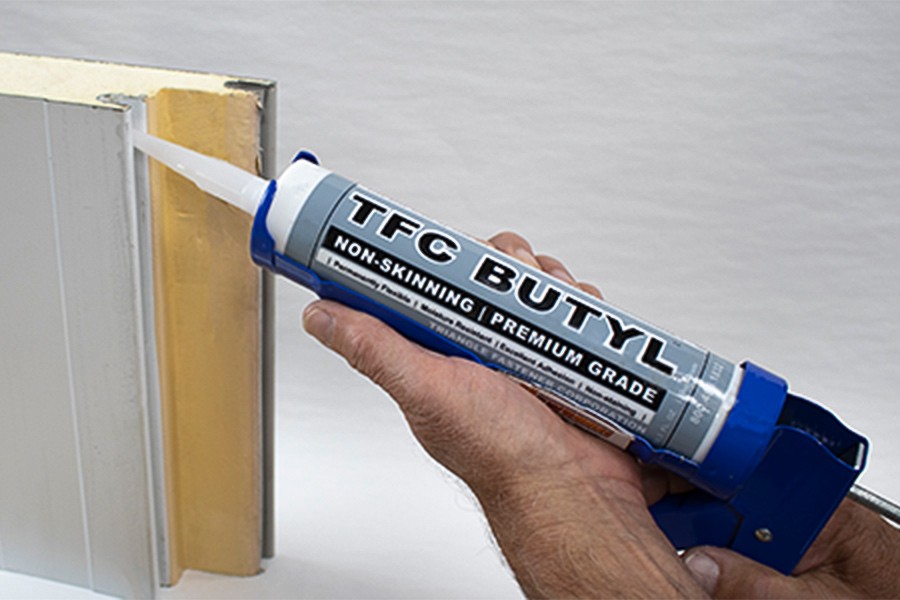
TFC BUTYL™ is a single-component butyl-based sealant designed specifically for strong adhesion to metal panels.
Its biggest distinction is that it remains permanently pliable. It does not skin over into a hard surface, which allows the material to continue moving with the joint after installation.
Why It Works Well With Metal Roofing
Metal panels do not stay perfectly still over the life of a building. Temperature changes create movement, and joints need a sealing product that can handle it.
TFC BUTYL remains flexible and moisture-resistant, which makes it useful for metal panel details where a rigid sealant would not be appropriate.
It also meets or exceeds AAMA 809.2 and is available in gray or white.
Installation Matters
Good adhesion starts with a clean surface. Before applying TFC BUTYL, the substrate should be dry and free from frost, oil, grease, incompatible coatings, or other contaminants that could interfere with adhesion.
The product is applied using a standard caulking gun and can be tooled after application if needed.
It is also worth paying attention to storage. TFC BUTYL should be kept in a controlled, dry environment below 75°F and used within 12 months of manufacture.
One other detail to know before choosing it: TFC BUTYL is not paintable.
Ask GNMC about TFC BUTYL™.
Best for: Seams, panel joints, and gaps that need a flexible cured sealant.
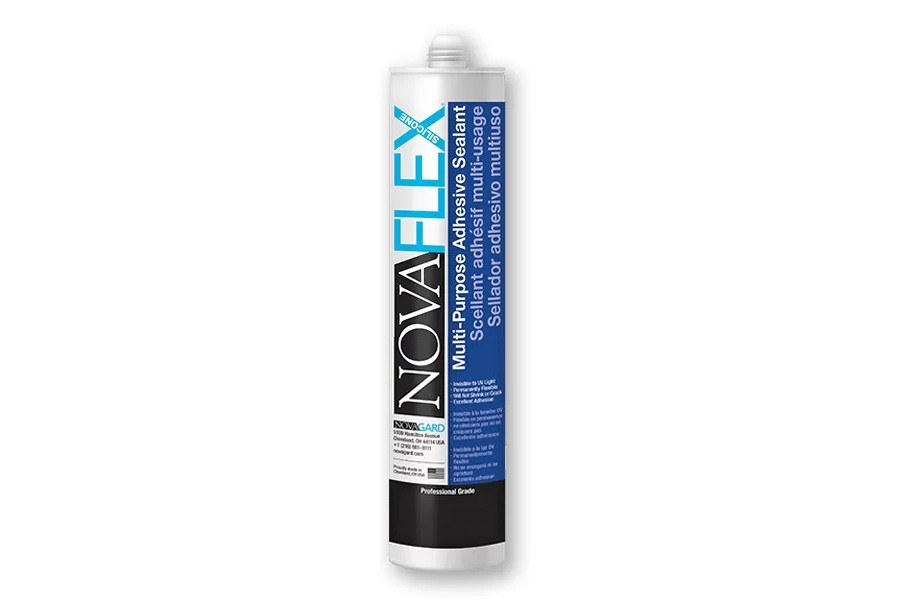
NovaFlex Metal Roof & Panel Adhesive Sealant is a single-component silicone sealant and adhesive commonly used as a seam sealant or joint filler in metal roofing and panel systems.
It is non-corrosive and non-sag, making it useful where contractors need a gun-grade product that will stay where it is placed.
Why It Works Well With Metal Roofing
Temperature range is one of NovaFlex’s standout characteristics. The product can be applied at temperatures from -20°F to 160°F and has a service temperature range of -40°F to 400°F.
That broad range is useful for metal roofing, where surfaces can experience substantial temperature swings.
NovaFlex also offers good adhesion to common building materials and can bridge gaps up to 3/8 inch. Its exterior weathering and aging performance make it suited to exposed building applications.
Where NovaFlex Makes Sense
Contractors may consider NovaFlex for:
- Metal roof seams
- Panel joints
- Joint filling
- Small gaps
- Details exposed to wide temperature swings
It remains flexible at temperatures down to -10°F and is freeze-thaw stable. There are a couple of limitations worth knowing before installation. NovaFlex is not recommended for joints that will be submerged underwater, and it should not be used on surfaces that will later be painted.
Cure time also depends on temperature and humidity, so installers should account for site conditions and follow the product instructions.
Contact GNMC about product availability.
Best for: Concealed metal building joints that need a continuous, flexible seal.
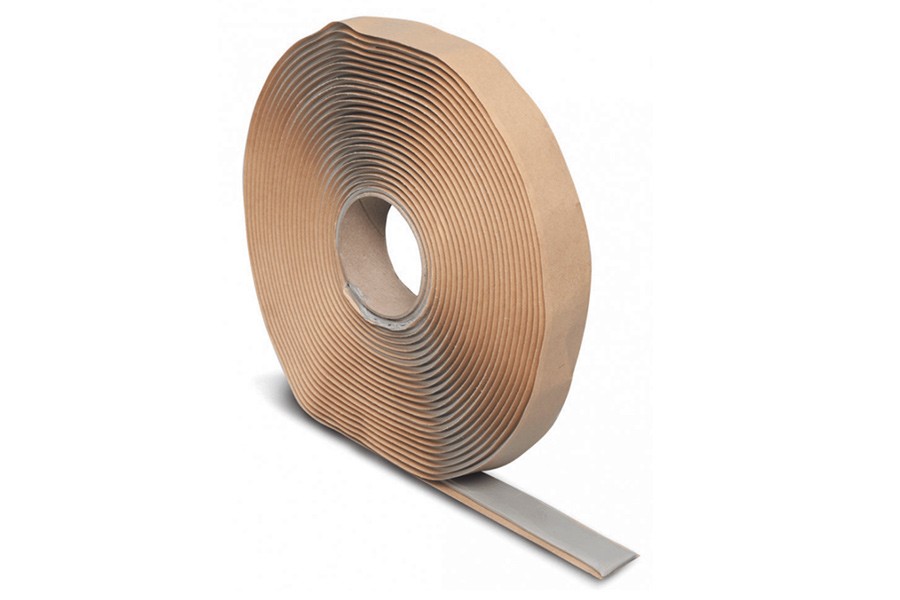
MB-10A Butyl Tape is an elastomeric butyl rubber sealant specifically designed around the requirements of metal buildings.
It comes extruded on silicone-coated release paper, which makes it straightforward to position during installation. It is also produced in different sizes and lengths to suit a range of applications.
Why It Works Well With Metal Roofing
MB-10A is designed to maintain its seal through normal building movement. Its combination of adhesive strength and cohesive strength helps the tape stay together and stay bonded as the assembly moves.
Temperature performance is another important benefit. MB-10A is designed to withstand extreme roof temperatures while maintaining compressibility in colder conditions. It also offers resistance to UV light and cold flow.
Those characteristics matter on metal buildings, where the material may experience a wide range of temperatures throughout the year.
Common Applications
MB-10A may be a good fit for:
- Concealed panel laps
- Metal building joints
- Overlapping components
- Details requiring a continuous butyl seal
- Joints affected by normal building movement
Choosing the right tape size is important. The joint needs enough material to create the intended seal without using so much that the tape squeezes excessively out of the detail.
Inquire about MB-10A Butyl Tape
What to Consider Before Choosing a Metal Roof Sealant
Before grabbing a tube or roll, look at what the joint actually needs and ask yourself the following questions:
- How Much Will the Joint Move? Metal panels expand and contract as temperatures change. A sealing product at a moving joint needs enough flexibility to accommodate that movement.
- What Temperatures Will the Product See? Metal roof surfaces can get hot, and Montana projects can also see very cold conditions. Check the product’s application temperature separately from its service temperature. A sealant may perform across a wide temperature range once cured while still having specific limits for installation.
- Is the Joint Exposed or Concealed? A concealed panel lap has different needs than an exposed seam. Butyl tape is often a practical choice where two materials are compressed together. A gun-grade sealant may make more sense when a seam or gap needs to be filled from the outside.
- What Materials Is the Product Touching? Always check compatibility with the metal substrate and any adjoining materials. A product that adheres well to bare metal may have different requirements around painted finishes, other coatings, plastics, or masonry.
- Will the Surface Be Painted? Some sealants are not paintable. Both TFC BUTYL and NovaFlex have limitations that should be understood before choosing them for a detail that will receive a finish later.
- What Does Installation Require? Good products still need good installation. Surface preparation, storage, bead size, compression, and cure time can all affect the finished seal. Read the product instructions before installation instead of assuming every sealant or tape works the same way.
Frequently Asked Questions About Metal Roof Sealants and Butyl Tape
What is the best sealant for a metal roof?
The best metal roof sealant depends on where it will be used. Gun-grade sealants can work well for seams and joints, while butyl tape is commonly used between overlapping components or in concealed joints. Movement, temperature, substrate compatibility, and exposure should all factor into the decision.
Is butyl tape good for metal roofing?
Yes. Butyl tape is well suited to many metal roofing details because it creates a continuous seal between components while remaining flexible enough to accommodate normal building movement.
Is sealant or butyl tape better for a metal roof?
Neither option is better for every application. Butyl tape is often used inside laps and concealed joints, while gun-grade sealants are useful for filling seams, joints, and gaps. Some details may use both as part of the roofing system.
Does metal roof sealant need to stay flexible?
For joints that experience movement, flexibility is important. Metal panels expand and contract as temperatures change, so the sealing product needs to accommodate the expected movement without losing adhesion.
Can you use any silicone sealant on a metal roof?
No. Use a sealant that is compatible with the roofing material, coating, joint design, and expected temperatures. The product instructions and roofing-system requirements should guide the choice.
Need Metal Roof Sealant or Butyl Tape for Your Next Project?
Great Northern Metal Company carries EMSEAL AST, TFC BUTYL™, NovaFlex, and MB-10A Butyl Tape for a range of metal roofing and metal building applications.
Tell our team what detail you are working on and what you need the product to do. We can help you review the options GNMC carries and get the right product information before you place an order.
Inquire About Metal Roof Sealants